

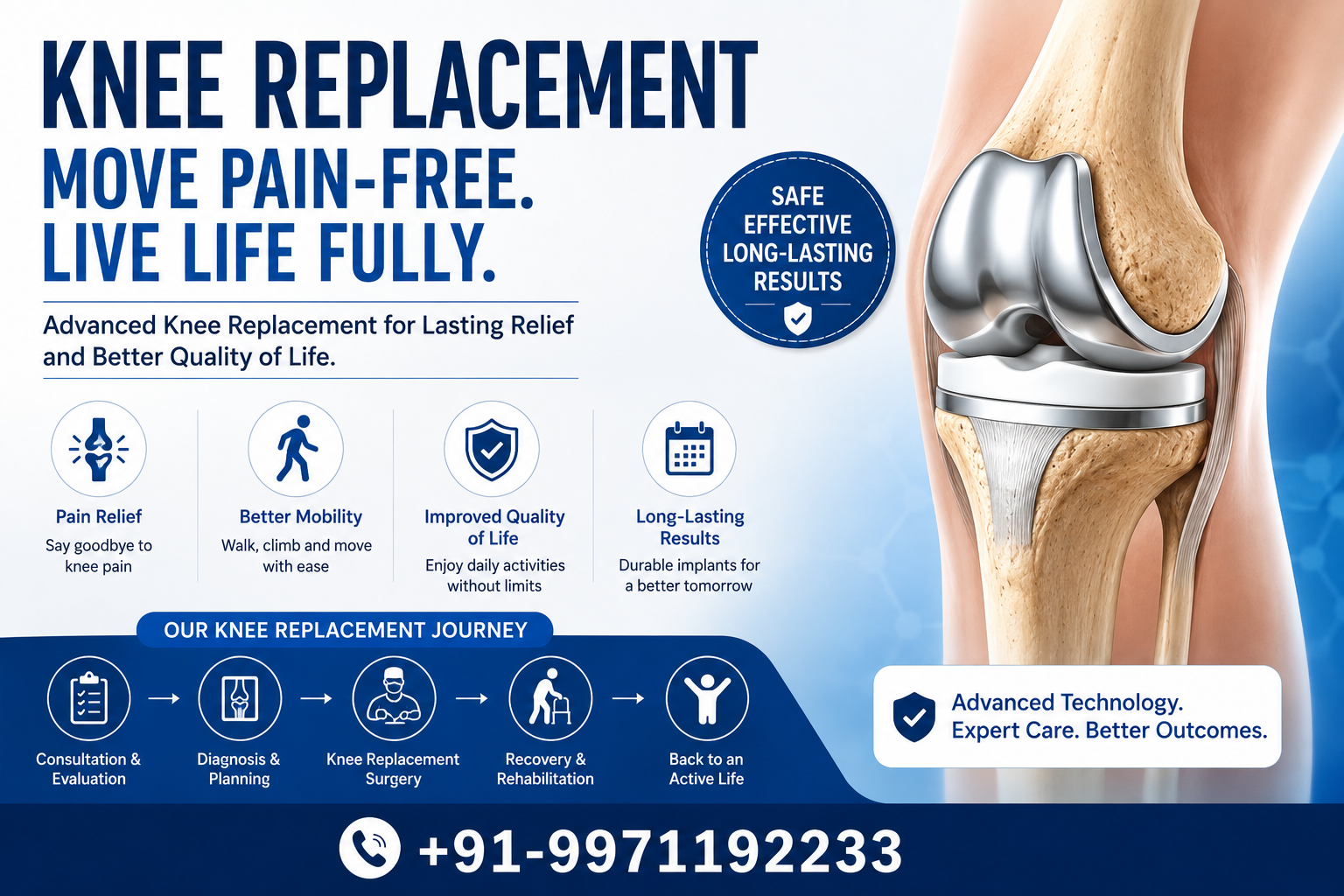
Knee pain can gradually change the way you walk, climb stairs, work, exercise, and enjoy everyday life. When medicines, physiotherapy, lifestyle changes, injections, and other non-surgical treatments no longer provide enough relief, knee replacement surgery may be recommended.
Knee replacement, also called knee arthroplasty, is a well-established procedure designed to reduce severe knee pain and improve mobility. During surgery, damaged portions of the knee joint are removed and replaced with specially designed artificial components.
If you are searching for information about knee replacement surgery, knee replacement cost, recovery after knee replacement, the best time for knee replacement, or life after knee replacement, this guide explains the important points in simple language.
Medical note: Knee replacement is not suitable for everyone. The decision should be based on your symptoms, examination, X-rays or other imaging, overall health, age, activity level, and response to non-surgical treatment. Always consult an experienced orthopaedic surgeon for personalised advice.
Knee replacement surgery is an operation in which damaged parts of the knee joint are replaced with artificial components, commonly called implants or prostheses.
A healthy knee allows smooth movement between the thigh bone, shin bone, and kneecap. In conditions such as advanced osteoarthritis, the protective cartilage can become severely damaged. This may cause bones to rub against each other, leading to pain, stiffness, swelling, and difficulty walking.
During knee replacement, the surgeon removes the severely damaged joint surfaces and replaces them with artificial components designed to restore smoother movement.
The main goals of knee replacement are to:
One of the most common questions patients ask is: “When should I consider knee replacement?”
Knee replacement is generally considered when knee damage becomes advanced and symptoms significantly interfere with daily life.
An orthopaedic surgeon may discuss surgery when a patient experiences:
Importantly, X-ray findings alone do not automatically mean that knee replacement is necessary. The severity of symptoms and their impact on your quality of life are also important.
The most common reason for knee replacement is advanced knee osteoarthritis.
Other conditions that can damage the knee joint include:
Osteoarthritis occurs when the cartilage that cushions the knee gradually wears down. It is one of the leading causes of chronic knee pain and disability.
Rheumatoid arthritis is an inflammatory condition that can damage the cartilage and other structures within the knee.
A previous knee injury or fracture may damage the joint and eventually lead to arthritis.
Some patients develop significant bow-legged or knock-kneed deformities associated with advanced joint damage.
Certain medical conditions or previous procedures can contribute to severe knee deterioration.
Knee replacement is not exactly the same for every patient. The type of surgery depends on which parts of the knee are damaged.
Total knee replacement, or total knee arthroplasty, is the most common form of knee replacement.
In this procedure, damaged surfaces of the thigh bone and shin bone are replaced with artificial components. The underside of the kneecap may also be treated depending on the patient's condition and the surgeon's assessment.
Total knee replacement may be considered when arthritis affects multiple compartments of the knee.
Partial knee replacement may be appropriate when arthritis is limited to one compartment of the knee and the remaining parts of the joint are relatively healthy.
It involves replacing only the damaged portion rather than the entire knee joint.
Not every patient with arthritis is suitable for partial knee replacement. Careful clinical and imaging assessment is required.
Robotic-assisted technology may be used to help the surgeon plan and perform certain knee replacement procedures.
The technology can assist with pre-operative planning, alignment assessment, and implant positioning. However, the robot does not independently perform the operation—the surgeon remains responsible for surgical decisions and execution.
Whether robotic-assisted surgery is appropriate depends on the patient's individual condition and the surgeon's approach.
The exact surgical technique can vary, but a typical knee replacement involves several important stages.
The surgeon evaluates:
The patient may also undergo blood tests, medical clearance, and other investigations before surgery.
Knee replacement is performed under anaesthesia. The anaesthesia team determines the most appropriate option based on the patient's health and surgical requirements.
The surgeon carefully removes damaged joint surfaces while preserving as much healthy bone and soft tissue as appropriate.
Artificial components are positioned on the prepared bone surfaces.
A medical-grade spacer is generally placed between the components to allow smooth movement and appropriate joint function.
The surgeon checks knee stability, movement, alignment, and implant positioning.
Once the procedure is complete, the surgical wound is closed and the patient is moved to the recovery area.
The duration of knee replacement surgery varies depending on the patient's condition, surgical technique, complexity, and other factors.
The operation itself commonly takes around one to two hours, although the overall hospital experience is longer because it includes preparation, anaesthesia, recovery, monitoring, and rehabilitation.
Your surgeon can provide a more accurate estimate after evaluating your individual case.
Patients understandably worry about pain after surgery.
Some pain and discomfort are expected during the early recovery period. However, modern pain-management strategies are used to control discomfort and help patients begin rehabilitation.
Pain usually improves progressively as healing and strengthening continue.
Your healthcare team may use a combination of medicines, physical therapy, ice or other supportive measures depending on your needs.
Recovery after knee replacement is a gradual process rather than an overnight transformation.
Many patients begin moving the knee and walking with assistance soon after surgery, depending on their condition and the surgeon's rehabilitation protocol.
During the initial period, the focus is usually on:
A physiotherapist may teach you exercises and walking techniques.
Patients gradually increase their walking and daily activities according to their recovery.
Physiotherapy plays an important role in restoring strength and range of motion.
Strength, confidence, mobility, and endurance generally continue to improve with consistent rehabilitation.
Recovery varies from person to person. Age, muscle strength, general health, pre-operative mobility, weight, surgical complexity, and adherence to rehabilitation can influence recovery.
Many patients are encouraged to stand and walk with assistance relatively soon after surgery when medically appropriate.
Initially, walking may require a walker or other support. Gradually, patients may progress to a cane and eventually walk independently.
The timeline is different for each person, so it is better to focus on safe and steady progress rather than comparing your recovery with someone else's.
Physiotherapy is a major part of successful rehabilitation.
A structured exercise programme can help improve:
Common exercises may include ankle movements, quadriceps activation, straight-leg raises, knee bending exercises, and progressive strengthening.
The exact exercise programme should be prescribed according to your recovery stage.
The objective of knee replacement is not simply to remove pain. It is also to help patients return to functional activities.
After adequate recovery and medical clearance, many patients can participate in activities such as:
High-impact activities that place excessive stress on the artificial joint may not be recommended.
Always ask your surgeon before returning to strenuous exercise or sports.
Modern knee replacement implants are designed to provide long-term function.
The longevity of an implant depends on multiple factors, including:
Many modern knee replacements can function well for 15 to 20 years or longer, but implant longevity varies between individuals.
Regular follow-up with your orthopaedic surgeon can help monitor the knee replacement over time.
Knee replacement is generally considered a successful treatment for advanced arthritis when appropriately selected patients undergo surgery and follow a suitable rehabilitation programme.
Patients commonly experience substantial improvement in pain and daily function.
However, no surgical procedure can guarantee a specific outcome for every patient.
Successful recovery depends on several factors, including accurate diagnosis, appropriate patient selection, surgical technique, implant positioning, rehabilitation, and the patient's overall health.
Like every major operation, knee replacement carries potential risks.
Possible complications include:
The overall risk varies depending on individual health and other factors.
Discuss potential complications with your surgeon before making a treatment decision.
The cost of knee replacement surgery varies considerably between patients and hospitals.
Factors that may affect the overall cost include:
Because of these variables, patients should ask the hospital for a detailed estimate rather than relying on a single general figure found online.
Insurance coverage may also vary according to the policy and treatment conditions.
Preparing for surgery can make the recovery period easier.
Your surgeon may recommend:
If possible, appropriate pre-operative exercises can help maintain muscle strength.
Conditions such as diabetes, high blood pressure, or other health problems should be appropriately managed before surgery.
Tell your doctor about all medicines and supplements you take. Do not stop prescribed medication without medical advice.
Arrange your home so that frequently used items are easy to reach. Reduce fall hazards and consider whether you need temporary support for bathing, stairs, or household activities.
Understand your physiotherapy programme and arrange transportation or assistance if necessary.
Patients should have realistic expectations.
Knee replacement is primarily performed to reduce pain and improve function. It does not necessarily create a completely “normal” knee.
Some patients may notice:
These experiences can vary significantly.
The goal is to achieve a comfortable, functional knee that allows you to perform everyday activities with greater ease.
Age alone does not determine whether someone needs knee replacement.
Although knee replacement is more commonly performed in older adults, younger patients may also require surgery when they have severe joint damage and significant symptoms.
The decision should consider:
The right time for surgery is an individual decision rather than a fixed age.
In some patients, symptoms can be managed without surgery, particularly when arthritis is not yet advanced.
Non-surgical treatments may include:
However, when severe arthritis causes persistent pain and major functional limitations despite appropriate conservative treatment, knee replacement may become a reasonable option.
You should consider an orthopaedic evaluation if knee pain is:
An evaluation does not automatically mean that you need surgery. A specialist can assess your condition and explain whether continued non-surgical treatment, another procedure, or knee replacement is appropriate.
Knee replacement is a surgical procedure that replaces damaged portions of the knee joint with artificial components to reduce pain and improve function.
Yes. Knee replacement is a major orthopaedic procedure, but it is routinely performed using modern surgical and rehabilitation protocols.
Advanced osteoarthritis is the most common reason patients undergo knee replacement.
The operation commonly takes around one to two hours, although the complete hospital process takes longer.
Many patients begin standing and walking with assistance soon after surgery when medically appropriate. The exact timeline depends on individual recovery.
Recovery is progressive. Many patients regain significant function within weeks to months, while strength and confidence can continue improving for several months.
Knee replacement implants are designed for long-term use, and many can function for 15–20 years or longer. Longevity varies between patients.
Yes. Many patients can return to stair climbing after adequate rehabilitation, although they may initially need assistance.
Driving should only resume when you are medically cleared, have adequate control of the operated leg, and can safely perform emergency braking.
Yes, many low-impact activities are possible after recovery. Your surgeon or physiotherapist can guide you regarding suitable exercises.
Some patients require replacement of both knees. Whether both knees should be treated at the same time or separately depends on individual health and surgical considerations.
Robotic assistance can provide additional planning and surgical guidance in selected cases, but it does not automatically mean a better result for every patient. The appropriate technique depends on individual circumstances.
Persistent severe pain, significant mobility limitations, advanced joint damage, and inadequate relief from appropriate non-surgical treatments are important factors. An orthopaedic evaluation is necessary.
There is no single best age. Surgery is considered based primarily on symptoms, joint damage, functional limitations, health, and treatment response.
Knee replacement treats the severely damaged joint surfaces in the operated knee. It does not cure arthritis as a systemic condition.
Knee replacement surgery can be a life-changing treatment for people living with severe knee arthritis and persistent pain. The procedure can reduce pain, improve mobility, and help patients return to many everyday activities.
However, surgery should not be viewed as the first option for every person with knee pain. A proper diagnosis and personalised assessment are essential.
If knee pain is affecting your walking, sleep, work, exercise, or quality of life despite appropriate treatment, consult an experienced knee replacement surgeon to understand your options.
The most important step is not simply choosing surgery—it is choosing the right treatment at the right time for your individual knee condition.
If you are experiencing persistent knee pain or difficulty walking, an orthopaedic consultation can help determine whether conservative treatment or knee replacement is appropriate for you.