

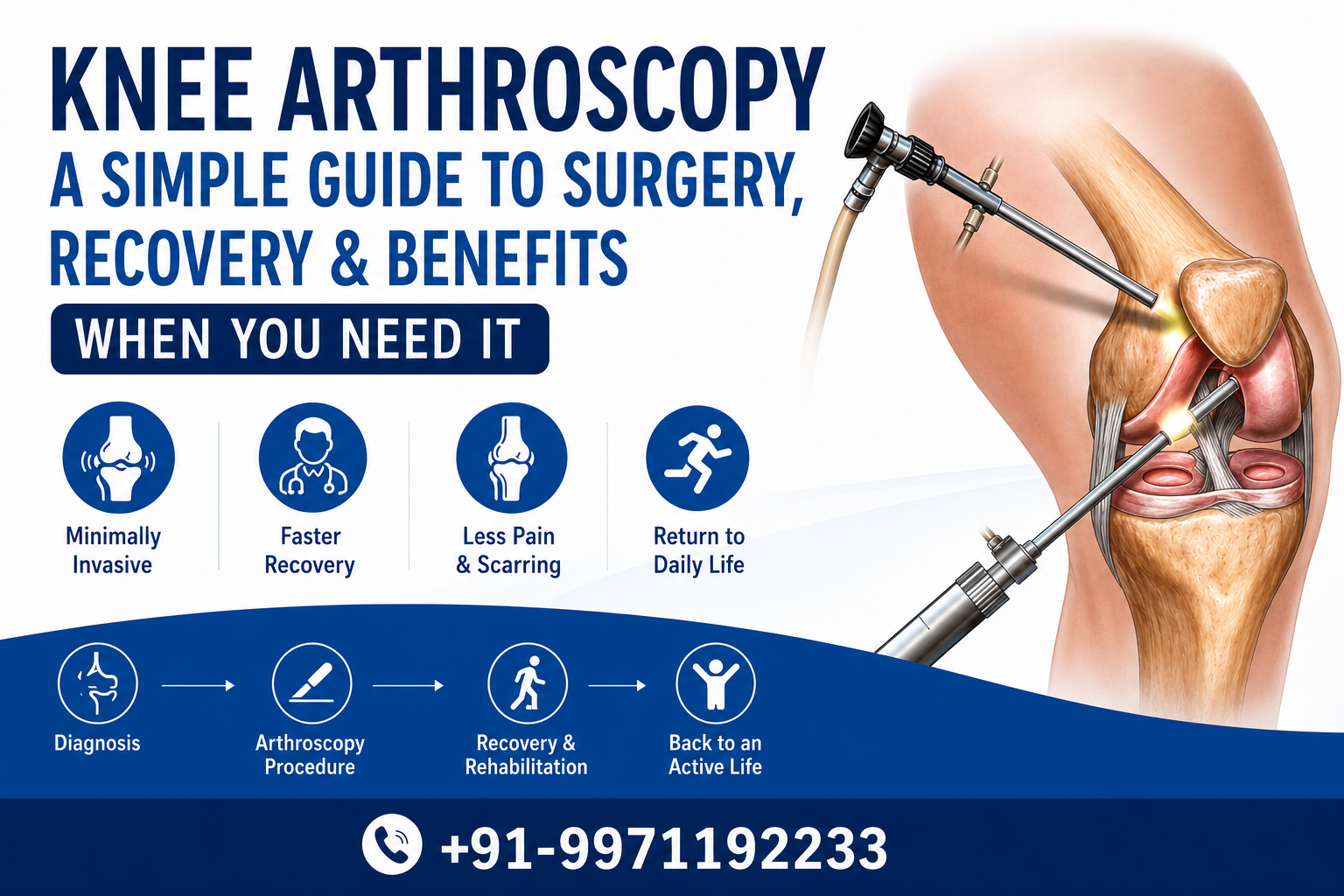
Knee pain can make simple activities like walking, climbing stairs, sitting, or exercising difficult. When medicines, physiotherapy, rest, or other non-surgical treatments do not provide enough relief, your orthopedic specialist may recommend knee arthroscopy.
Knee arthroscopy is a minimally invasive procedure that allows an orthopedic surgeon to examine and, when appropriate, treat problems inside the knee through small incisions. Dr. Shekhar Srivastav provides orthopedic and arthroscopic care for patients looking for treatment options for knee injuries and conditions.
In this guide, we explain what knee arthroscopy is, why it is performed, which knee problems it can treat, how the procedure works, recovery time, benefits, risks, and frequently asked questions in simple language.
Knee arthroscopy is a minimally invasive surgical procedure used to diagnose and treat certain problems inside the knee joint.
During the procedure, the surgeon makes small openings around the knee and inserts a thin instrument called an arthroscope. The arthroscope has a small camera that sends images to a monitor, allowing the surgeon to view structures inside the knee.
Depending on the problem, additional small instruments may be used through other incisions to perform the required treatment.
Because knee arthroscopy generally uses small incisions rather than one large opening, it may offer advantages such as less tissue disruption and, for appropriate patients, a potentially quicker recovery than some traditional open procedures.
However, arthroscopy is not automatically the best treatment for every type of knee pain. The correct treatment depends on the underlying diagnosis, symptoms, examination findings, imaging, age, activity level, and overall health.
Knee arthroscopy may be recommended when a patient has a specific problem inside or around the knee that may benefit from minimally invasive treatment.
Common reasons for considering knee arthroscopy include:
One important point is that not every knee problem requires arthroscopic surgery. For example, many cases of knee arthritis are managed initially with exercise, physiotherapy, medicines, weight management where appropriate, injections, activity modification, or other treatments.
A proper orthopedic evaluation helps determine whether surgery is appropriate.
A person may be considered for knee arthroscopy when symptoms are related to a condition that can potentially be addressed through arthroscopic treatment.
Typical symptoms may include:
The presence of these symptoms does not automatically mean that arthroscopy is required.
An orthopedic surgeon may evaluate your medical history, perform a physical examination, and recommend imaging such as an X-ray or MRI when appropriate.
The meniscus is a cartilage structure that helps distribute load and provides stability within the knee.
A meniscus can tear because of a sports injury, twisting movement, accident, or age-related changes.
Depending on the location, type, size, and characteristics of the tear, treatment may involve rehabilitation, medication, activity modification, or surgery.
In selected cases, arthroscopy can be used to repair the meniscus or remove only the damaged portion when repair is not appropriate.
The smooth cartilage covering the ends of bones helps the knee move with less friction.
Cartilage damage may occur following injury or as part of degenerative changes.
Certain cartilage injuries can be assessed and treated using arthroscopic techniques. The exact treatment depends on the size, location, depth, and cause of the cartilage damage.
Sometimes small pieces of bone or cartilage can become loose inside the knee joint.
These loose bodies may cause:
In selected patients, arthroscopy can be used to locate and remove loose bodies.
Some knee ligament injuries require surgical reconstruction, particularly when instability affects an active person or when the injury meets specific treatment criteria.
ACL reconstruction, for example, is commonly performed using arthroscopic techniques.
Whether surgery is needed depends on factors such as the patient's age, activity level, instability, associated injuries, and treatment goals.
Knee arthroscopy is usually performed in a hospital or surgical facility under appropriate anesthesia.
The general process may include:
Before surgery, the orthopedic team reviews your symptoms, medical history, medications, allergies, examination findings, and relevant imaging.
The type of anesthesia and surgical plan are discussed before the procedure.
Depending on the individual case and surgical plan, regional or general anesthesia may be used.
The surgeon creates small openings around the knee.
A small camera is introduced through one of the openings. The camera provides a magnified view of structures inside the knee.
Specialized instruments may be introduced through other small openings.
Depending on the diagnosis, the surgeon may repair or treat the affected structure.
After the procedure, the instruments are removed and the small incisions are closed appropriately. The patient is then monitored during recovery from anesthesia.
The exact procedure and duration vary according to the condition being treated.
For appropriately selected patients, knee arthroscopy may provide several potential advantages.
Arthroscopy generally uses small surgical openings rather than a large incision.
Because the procedure is performed through small access points, there may be less disruption to surrounding tissues compared with certain open procedures.
The arthroscope allows the surgeon to directly visualize structures within the knee while performing appropriate treatment.
Recovery varies considerably depending on the procedure. Some arthroscopic treatments may allow a relatively faster return to normal activities than more extensive surgery.
Arthroscopy allows the surgeon to address specific internal knee problems through minimally invasive techniques.
It is important to remember that the benefits and recovery timeline depend on the exact procedure performed.
Some discomfort, swelling, and stiffness can occur after knee arthroscopy.
Pain management may include prescribed medication, ice application, elevation, activity modification, and rehabilitation as recommended by the treating medical team.
The amount of pain varies depending on:
Following postoperative instructions can help support recovery.
Knee arthroscopy recovery time varies from patient to patient and depends heavily on the procedure performed.
Some diagnostic or relatively minor arthroscopic procedures may allow a quicker return to everyday activities, while procedures such as meniscus repair or ACL reconstruction require a longer rehabilitation program.
Recovery may involve:
You should not compare your recovery with another patient's recovery because different knee conditions require different rehabilitation protocols.
Physiotherapy can be an important part of recovery after many knee arthroscopy procedures.
A rehabilitation program may focus on:
The rehabilitation plan should be individualized according to the surgery and your recovery.
If your surgeon recommends physiotherapy, following the prescribed program consistently can be important for achieving the best possible functional recovery.
There is no single walking timeline that applies to every knee arthroscopy patient.
Some patients may be allowed to put weight on the leg soon after certain procedures, while others may need crutches and restricted weight-bearing for a period of time.
For example, rehabilitation after a simple arthroscopic procedure may be very different from rehabilitation after a meniscus repair or ACL reconstruction.
Always follow the specific weight-bearing instructions provided by your orthopedic surgeon.
Returning to sports depends on:
Returning too quickly can increase the risk of reinjury.
Athletes should generally return to sports only after their treating orthopedic team confirms that the knee has recovered sufficiently for the required activity.
Knee arthroscopy is a commonly performed orthopedic procedure, but like every surgery, it has potential risks.
Possible complications can include:
The actual risk depends on the patient's health, the procedure performed, and other individual factors.
Your surgeon should explain the expected benefits, alternatives, and potential risks before surgery.
The major difference is the surgical approach.
Arthroscopy uses a camera and specialized instruments inserted through small openings.
Open surgery generally requires a larger incision to access the affected area.
Arthroscopy can be an excellent option for certain internal knee problems, but open surgery may be more appropriate for some conditions.
The goal is not simply to choose the smallest incision. The goal is to select the most appropriate treatment for the patient's specific knee problem.
This is one of the most common questions patients ask.
Knee arthroscopy is not a universal treatment for knee arthritis.
For many people with degenerative knee arthritis, treatment may begin with non-surgical measures such as:
Arthroscopy may have a role in selected circumstances when there is another treatable mechanical problem inside the knee.
A detailed evaluation is necessary before deciding on surgery.
Choosing an orthopedic surgeon for knee treatment involves more than looking at the procedure itself.
A good evaluation should consider:
Dr. Shekhar Srivastav focuses on orthopedic and arthroscopic evaluation and treatment, helping patients understand their condition and available treatment options.
The right approach is always patient-specific rather than based only on the name of a procedure.
Your surgeon and hospital team will provide specific instructions before surgery.
Depending on your case, preparation may involve:
Do not stop or change prescribed medicines unless your medical team tells you to do so.
After surgery, your medical team will provide instructions about wound care, medication, walking, exercise, and follow-up appointments.
You may experience some swelling or stiffness during the early recovery period.
Contact your medical team if you develop symptoms that concern you, particularly increasing pain, significant swelling, fever, wound discharge, breathing difficulty, or other unexpected symptoms.
Knee arthroscopy is a minimally invasive procedure in which a small camera is inserted into the knee joint to examine and, when appropriate, treat certain knee problems.
The complexity of knee arthroscopy varies. Some procedures are relatively minor, while procedures such as ligament reconstruction or certain repairs involve more extensive treatment and rehabilitation.
The duration depends on the diagnosis and procedure being performed. Your surgeon can provide a more accurate estimate after evaluating your knee.
Walking depends on the procedure. Some patients can bear weight relatively soon, while others need crutches and restricted weight-bearing.
Recovery can range from a relatively short period for some procedures to several months for more complex repairs or reconstructions.
You may be able to climb stairs when your surgeon or physiotherapist considers it safe. The timing depends on your procedure, strength, balance, and weight-bearing restrictions.
Physiotherapy is commonly recommended after many arthroscopic procedures, particularly when restoring strength, movement, stability, and function is important.
In selected cases, yes. Depending on the type and location of the tear, the surgeon may repair the meniscus or remove only the damaged portion when repair is not suitable.
Arthroscopic techniques are commonly used for ACL reconstruction when surgery is appropriate. The decision depends on the patient's injury and individual circumstances.
Neither approach is universally better. The appropriate procedure depends on the specific knee condition, treatment goals, and clinical findings.
Knee arthroscopy does not cure general knee arthritis. Treatment for arthritis depends on its severity and symptoms and may include non-surgical or surgical options.
Small scars can remain where the arthroscopic instruments were inserted. Their appearance varies between individuals.
Many patients can return to sports after appropriate rehabilitation, but the timeline depends on the injury, surgery, strength, stability, and sport involved.
Potential risks include infection, bleeding, blood clots, stiffness, persistent symptoms, anesthesia-related complications, and injury to surrounding structures.
Consider an orthopedic evaluation if knee pain persists, repeatedly swells, locks, feels unstable, follows a significant injury, or interferes with normal daily activities.
Persistent knee pain should not always be treated as a normal part of aging or physical activity.
If you experience recurrent knee swelling, locking, instability, pain after a sports injury, difficulty walking, or persistent symptoms despite conservative treatment, an orthopedic assessment may help identify the underlying cause.
Dr. Shekhar Srivastav can evaluate your knee condition and discuss whether knee arthroscopy, physiotherapy, medication, activity modification, or another treatment approach may be appropriate.
The objective of treatment is not simply to perform surgery. It is to identify the cause of the problem and choose a treatment plan suited to the individual patient.
Knee arthroscopy is a minimally invasive orthopedic procedure that can diagnose and treat selected problems inside the knee. It may be useful for conditions such as certain meniscus tears, loose bodies, cartilage problems, and ligament injuries.
However, arthroscopy is not necessary for every patient with knee pain, and the best treatment depends on an accurate diagnosis.
If knee pain, swelling, locking, or instability is affecting your daily life, getting an evaluation from an experienced orthopedic and arthroscopic specialist can help you understand your treatment options.
For patients seeking knee arthroscopy in Delhi, Dr. Shekhar Srivastav provides orthopedic evaluation and arthroscopic treatment based on the patient's individual condition and requirements.